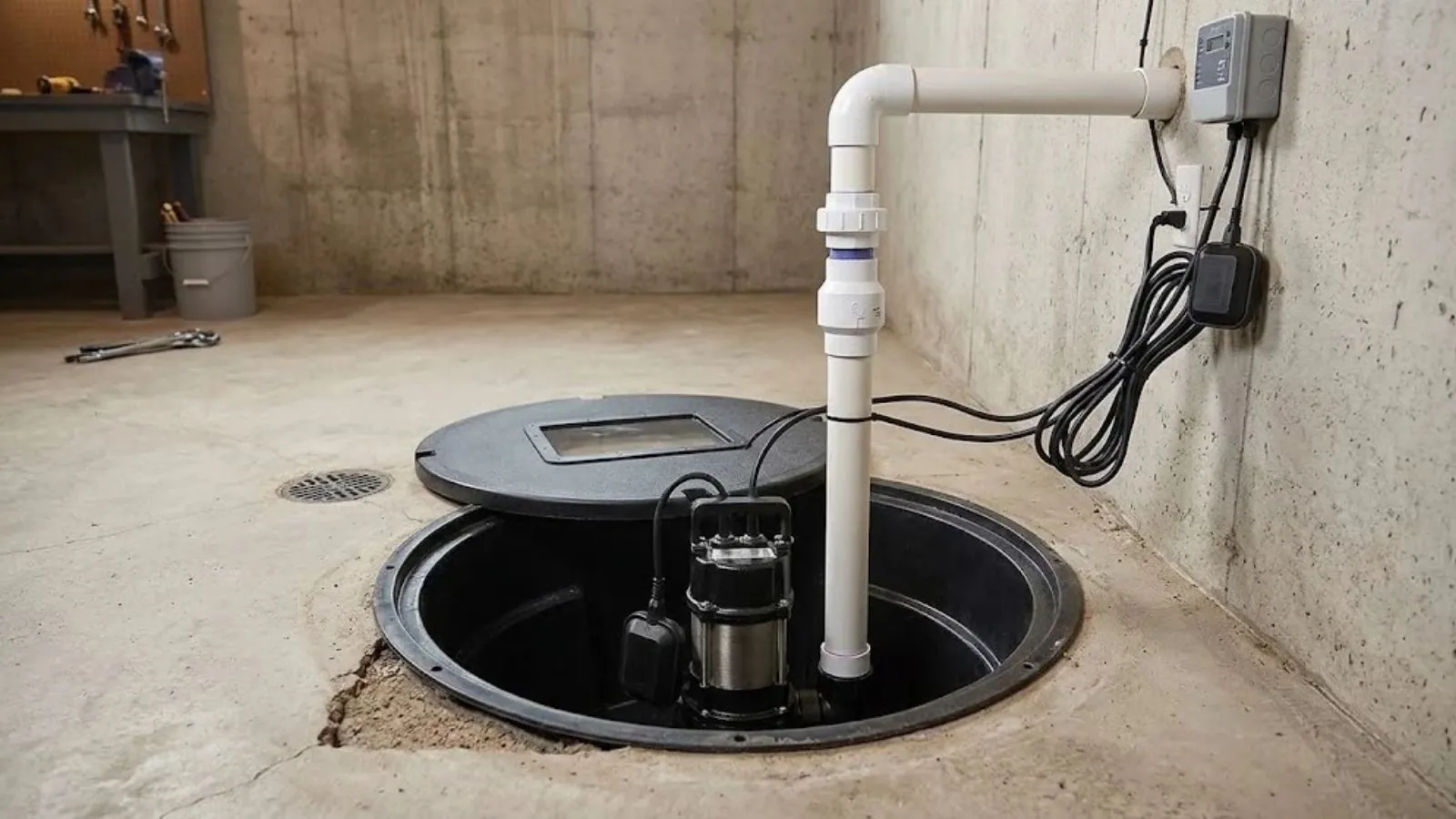
Most Upland homes do not have a sump pump, because basements are uncommon in Southern California. That makes the homes that do have one easy to overlook until the day it fails. A pump that has sat unused for most of a dry year can fail the first time a real storm sends water into the pit.
Where we do find them in and around Upland is fairly specific. One place is lower levels and daylight basements on hillside lots in San Antonio Heights. Another is below-grade garages and stairwells at multi-family and commercial buildings. A third is sewage ejector pumps serving a bathroom, laundry, or accessory unit that sits below the line of the sewer. Each one is a pump with a single job, and each one needs to work the moment water arrives.
Why Sump Pumps Fail When You Need Them Most
The most common failure we see is a stuck float switch. The float rides up and down with the water in the pit, and when it jams against the wall of the basin or a cord, the pump either never starts or never stops. A pump that runs dry will burn out its motor, and one that never starts lets the pit overflow.
It also helps to know which kind of pump you have. A sump pump moves groundwater or storm runoff out of an open basin. A sewage ejector pump lifts wastewater from a fixture below the sewer line through a sealed, vented basin. A failed sump pump means water on the floor, and a failed ejector pump means a sewage backup, which is always an emergency.
Check valves are the second culprit. A failed check valve lets water in the discharge pipe fall back into the pit after every cycle, so the pump short-cycles and wears out early. Clogged intakes, tripped breakers, and a discharge line that is frozen or blocked complete the usual list. Pumps also simply age out, and a unit past roughly ten years is living on borrowed time.
Upland sits at the foot of the San Gabriel Mountains, and the storms that do reach the foothills tend to arrive hard, sending runoff down the slope toward whatever is lowest. Properties below a hillside, behind a retaining wall, or with a sunken entry or stairwell are the ones where a working pump matters most. If water has already reached a floor or wall, our water damage restoration team can start drying right away.
Signs Your Sump Pump Needs Attention
Water Standing In The Pit
If the pit is full and the pump is not running, the float or the motor has likely failed.
Pump Runs Constantly Or Cycles Rapidly
Often a failed check valve or a stuck float, and a sign the motor is wearing out.
Loud Grinding Or Rattling
Usually worn bearings or debris in the impeller, and the pump may not last long.
Musty Smell Or Damp Lower Level
Can mean water is getting past a pump that is not keeping up.
Water Rising In The Pit Right Now?
Call our 24/7 line and we will dispatch a plumber right away.
How We Fix It
Test
Check power, float switch, and discharge flow.
Diagnose
Find whether it is the pump, the valve, or the discharge line.
Repair Or Replace
Fix the failed part, or replace an aging pump.
Verify
Fill the pit and watch a full cycle before we leave.
When Repair Still Makes Sense
Consider Replacement If
- The pump is around 10 years old or older
- The motor is noisy, hot, or running constantly
- It has failed more than once in a few years
- The housing is cracked or corroded
Repair Usually Works If
- The pump is under about 7 years old
- The problem is a stuck float switch or tripped breaker
- A failed check valve is the only issue
- The intake is simply clogged with debris
If Water Is Rising Before Help Arrives
A failing pump during a storm is stressful, and a few safe steps limit the damage while you wait for a plumber. Electricity and water are a dangerous mix, so safety comes before saving belongings.
What to do while you wait for a plumber
- Do not wade into standing water if outlets, cords, or the electrical panel could be wet
- If it is safe to reach, turn off the breaker for the pump and nearby lower-level outlets
- Move valuables and furniture to higher ground or off the floor
- Call our 24/7 line and tell us whether the pit holds rainwater or wastewater
Hillsides, Garages, And Lower Levels Around Upland
On the hillside streets of San Antonio Heights, a lower level or sunken entry can sit below the grade of the slope behind it, and a sump basin with a properly routed discharge keeps that runoff from collecting against the foundation. Along Foothill Boulevard and around Historic Downtown, the work is more often a below-grade parking structure or a stairwell drain at a commercial or multi-family property, where a failed pump can flood a garage overnight.
For any installation, we size the pump to the basin and the expected inflow, add a check valve, and route the discharge to an approved location under the California Plumbing Code (UPC) and local storm-water rules. A battery backup is worth considering anywhere power loss during a storm is a real possibility, since the outages that come with storms are exactly when a pump is needed.
What Sump Pump Repair & Installation Costs In Upland
Exact quote after inspection, before any work begins.
Many homeowner policies exclude sump pump overflow and sewer backup unless a water backup endorsement was added, so it is worth checking your policy before a storm season.
Emergency Sump Pump Failure
A sump pump failure is an emergency when water is rising in the pit or the pump runs without moving water. Do not wait for the next rain, since the failure often shows up during a storm.
Our emergency plumber tests the pump, checks the float and discharge line and repairs or replaces the pump. We answer 24 hours a day.
Common Questions
Do you repair sump pumps in an emergency?
Yes. Call (909) 505-3225 any hour if your sump pump stops or water is rising in the pit.
Do homes in Upland really have sump pumps?
Not many, since basements are uncommon here. We mostly see them on hillside lots with lower levels, at buildings with below-grade garages or stairwells, and as sewage ejector pumps serving fixtures below the sewer line.
How long does a sump pump last?
Typically around ten years, depending on how often it runs. A pump that has rarely cycled can still fail from sitting idle, so a test before the rainy season is worthwhile.
Can you tell whether my pit has a sump pump or a sewage ejector?
Yes. A sealed, vented basin tied into the sewer line is an ejector pump, and an open basin collecting groundwater or runoff is a sump pump. The difference matters for the repair and for how urgent it is.
Should I add a battery backup?
If a power outage during a storm could leave the pit without a working pump, yes. We can add a backup system to an existing pump or include it in a new installation.